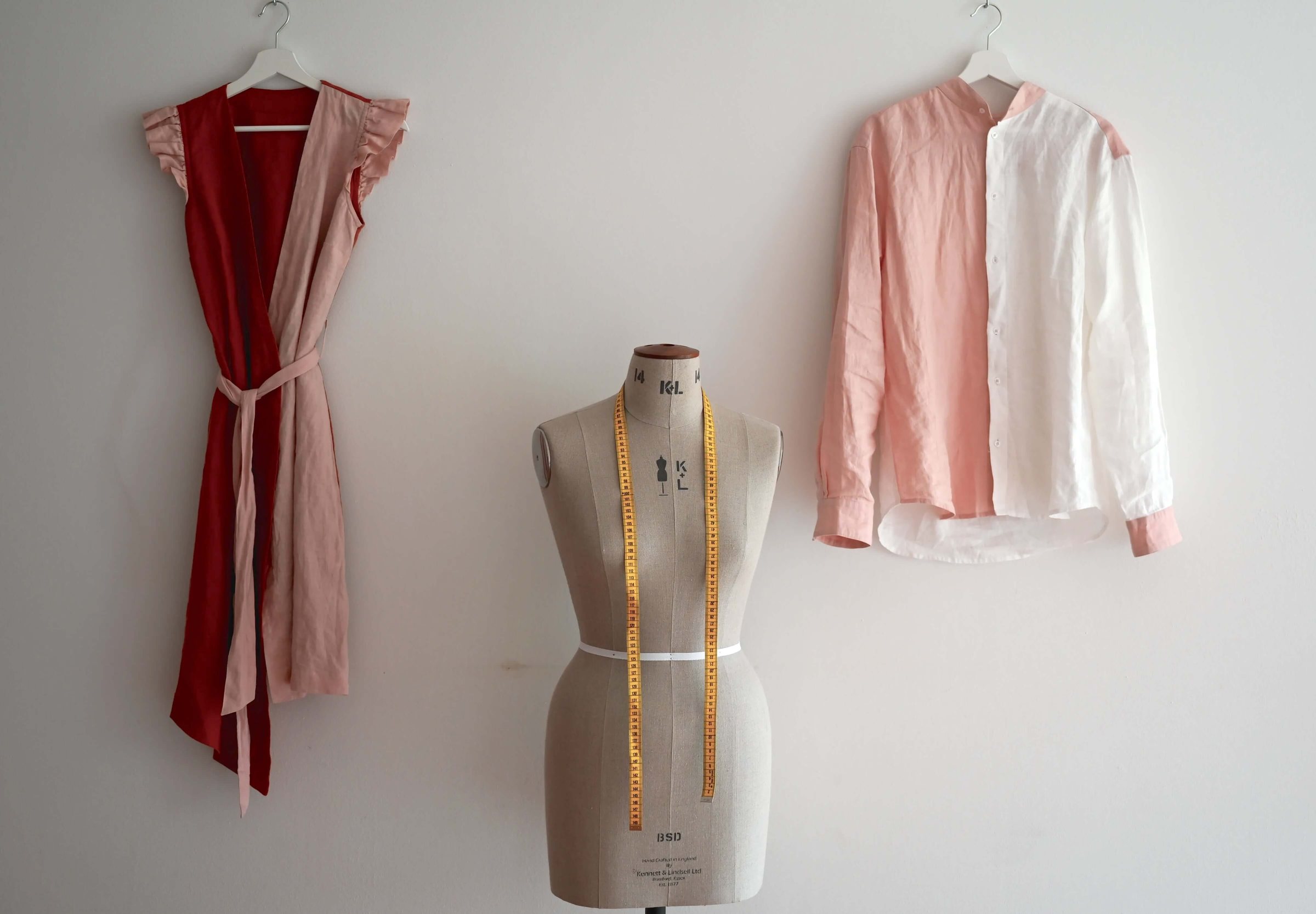
Revivewear Explained: Buying Previously Owned and Sample HACOY Pieces
Key Takeaways
- What it is: Revivewear is where HACOY sells the pieces that came back. Garments worn once for a shooting, samples made for the showroom, and pieces carrying a visible mark we chose not to destroy.
- Every piece exists once: the stock number you see is the whole story. There is one of each, in one size.
- Its own price: A Revivewear piece is its own product at its own price, set by its condition, which is why you will never see a struck through price next to it.
Garments that come back from a shooting have been worn for two hours under a light, and they cannot be sold as new. We did not want to write them off, so we built Revivewear to find each of them an owner.
The three conditions, and what each one means
Every Revivewear piece is graded before it goes online, and the grade sets the price. We would rather tell you exactly what is wrong with a garment than photograph around it.
| Condition | What it means | | --- | --- | | Sample Piece | Made for the showroom. It has never belonged to a customer, and in most cases it is a colour or a cut that never went into production. | | Previously owned | Worn, usually for a shooting or a stretch in the showroom, then returned to us. No visible fault. | | Perfectly Imperfect | Carries a visible mark. Faded in places, a small stain, a washed out print, a missing care label, or an older production run whose colour sits slightly differently from the current one. The listing always names the specific fault. |
The price reflects what the garment is, and nothing more.
The pieces that are worth more, not less
One group breaks the pattern entirely. During a studio session a handful of our sportswear pieces were painted by hand, and they came back covered in blue, lilac, teal and pink worked across the fabric until the black underneath barely shows. Our first instinct was to file them as damaged.
They are not damaged. They are the only ones that will ever exist in that pattern, because nobody could repeat those marks if they tried. So the painted capsule sits at full price, alongside the regular collection. There are five pieces in total, a shirt, a top, shorts, leggings and a pair of trousers, and of each one there is exactly one.
How to buy a piece that exists once
Shopping Revivewear works differently from the main collection, in three ways worth knowing before you start.
There is one size per piece. A garment came back in a size L, so the listing offers L and nothing else. If your size is not there, it is not hiding in the back, it does not exist. Our sizing starts at S and runs to XL across the collection, but any individual Revivewear listing carries only what physically returned.
Stock is literal. When a listing says one in stock, there is one garment on a shelf in our Munich showroom. Two people cannot buy it. We deliberately do not allow overselling on these pieces, so nothing is sold that we cannot ship.
Some pieces are halves. A few bikini tops and bottoms came back on their own, so they are sold on their own. Look for Top only or Bottom only in the size selector.
What you are actually buying
The garment underneath is unchanged. A previously owned Monogram Bathing Suit is the same suit, made near Ferrara in Italy, as the one at full price. Our linen Workwear is made near Vilnius in Lithuania, our swim and sportswear near Ferrara in Italy, and a Revivewear piece carries the same origin, the same materials and the same Meet your piece passport as its full price counterpart.
It also sits inside the same Circular Orbit afterwards. A seam or a button can be mended, and repair is part of our Circular Orbit and complimentary for every owner. If a Revivewear piece needs work, write to hello@hacoy.com and we bring it back at no cost, exactly as we would for a garment bought at full price. A repaired garment keeps its Meet your piece passport, so its history stays with it.
Why the price follows the garment
The prices of the main collection stay as they are. What changes is the garment itself, and the price follows the garment. When a piece has been worn, we say so, we price it for what it now is, and the piece next to it at full price stays exactly where it was.
The current selection is here, and it changes as pieces sell and as more come back from shootings. If you want the reasoning behind all of this, Maximilian wrote about it in the HACOY Journal.
Written with the help of AI, edited by HACOY in Munich.